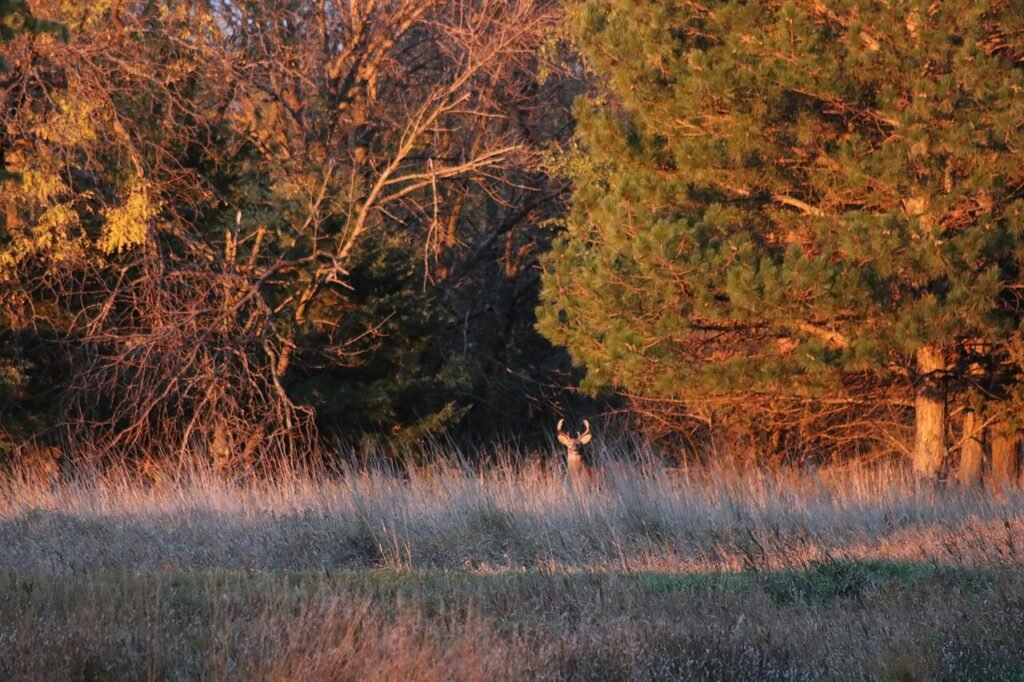
If you drive anywhere in Kansas this month, you have probably noticed it already. Deer are everywhere. They are in the ditches, at the edge of the tree lines, and sometimes standing right in the middle of the road like they own it. November is rut season, and it is the most dangerous month of the year for deer and drivers to meet.

Why November Is Deer Month on Kansas Roads
The rut is the white-tailed deer mating season. Bucks are out looking for does, and they are not paying much attention to anything else, including your headlights. The Kansas Department of Transportation says vehicle-deer crashes go way up in the fall, and November is the peak.
Levi Jaster, the big game coordinator for Kansas Department of Wildlife and Parks (KDWP), put it simply in KDOT’s October 2026 safety release: “Deer are focused on mating and not paying attention to hazards like vehicles.” He also pointed out that with crops out of the fields and leaves off the trees, deer have fewer places to hide, so we see more of them on and near the roads, especially at dawn and dusk.
Kansas Deer-Vehicle Crashes: The Numbers Are No Joke
According to KDOT, Kansas had 10,742 deer-vehicle crashes in 2025. One person was killed and 692 people were injured. Across the state, 40% of all single-vehicle crashes in 2025 involved hitting a deer. That is not a typo. Four out of ten.
It hits the wallet too. AAA Kansas says the average Kansas insurance claim for an animal strike in 2025 was almost $7,900, up 42% in five years, mostly because of all the cameras and sensors packed into newer vehicles.
How to Lower Your Odds of Hitting a Deer
These tips come straight from KDOT, the Kansas Highway Patrol, and KDWP:
- Be extra watchful at dawn and dusk, when deer are most active.
- If you see one deer, expect more. They seldom travel alone.
- Slow down near wooded areas, parks, creeks, and ponds.
- Use your bright lights when there is no oncoming traffic, and watch for eyes reflecting back at you.
- Always wear your seat belt and keep children in proper car seats.
- Do not swerve. Brake firmly and stay in your lane. Swerving is how a deer crash turns into a head-on crash or a rollover.
That last one is the hardest. Every instinct says to jerk the wheel. Kansas Highway Patrol Lt. Chad Crittenden said drivers are often safer when they brake firmly and stay in their lane, and I believe him.
If You Do Hit One
- Pull as far onto the shoulder as you can and turn on your hazard lights.
- Call for help: *47 reaches Kansas Highway Patrol dispatch, *582 (*KTA) works on the Kansas Turnpike, or dial 911.
- If you can, stay in your vehicle with your seat belt on. You are safer there than standing on the shoulder.
- Do not worry about the deer. Law enforcement will handle getting it off the road.
- Call your insurance company to report the damage.
KDWP also notes that any crash with injury or $1,000 or more in property damage has to be reported right away to the nearest law enforcement agency. With repair costs where they are now, almost any deer hit will clear that bar.
Can You Keep the Deer?
This is the question every homesteader asks. In Kansas, you need a salvage tag to take all or part of a deer from a crash site, and that includes the antlers. A KHP trooper, a sheriff’s deputy, or a KDWP game warden can issue one. If you take the deer, you are responsible for the whole animal, not just the rack. Done right, that is a lot of good meat that does not go to waste.
Firearm Season Is Right Around the Corner
For the hunters, archery season runs through December 31, and the regular firearm deer season opens statewide on December 2 and runs through December 13, 2026, according to KDWP. So the deer are moving now, and in a few weeks a lot more of us will be out there too. Check the KDWP deer page for permits and unit rules before you go.
Until then, slow down, watch those ditches, and do not swerve. Have you had a close call with a deer this fall? Tell me about it in the comments.
Bird hunters can also check our guide to Kansas pheasant and quail season 2026 dates.
Sources
- KDOT: Motorists encouraged to be on the lookout for deer (Oct. 14, 2026)
- KDWP: Wildlife Vehicle Crashes
- KDWP: Salvage Tag
- KDWP: 2026-2027 Deer Season Dates
Photo: White-tailed buck at the edge of a tree line, U.S. Fish and Wildlife Service, public domain, via Wikimedia Commons.